
Microsoft is enhancing the Implementation Portal for Dynamics 365 with business process visualization. This gives customers and partners access to the Microsoft Business Process Catalog directly within the project profiling experience.
Powered by Mavim, this new visualization capability helps implementation teams explore standard business processes, align on project scope, and make more informed implementation decisions earlier in the implementation lifecycle.
Successful implementations begin with a shared understanding of business processes. Before solution design, configuration, or deployment, project teams must agree on which business processes are in scope. They also agree on where standard capabilities meet business requirements and where unique business needs may require additional planning. The Implementation Portal now surfaces Microsoft Business Process Catalog context at the start of implementation planning.
Bringing business process context into project profiling
The Implementation Portal helps customers and implementation partners define the scope of a Dynamics 365 project. During project profiling, teams identify the products, capabilities, and business processes that will shape the implementation.
With this release, teams can now explore standard business process diagrams from the Microsoft Business Process Catalog without leaving the Implementation Portal. Teams can review process flows during project scoping, building a shared understanding across stakeholders from day one.
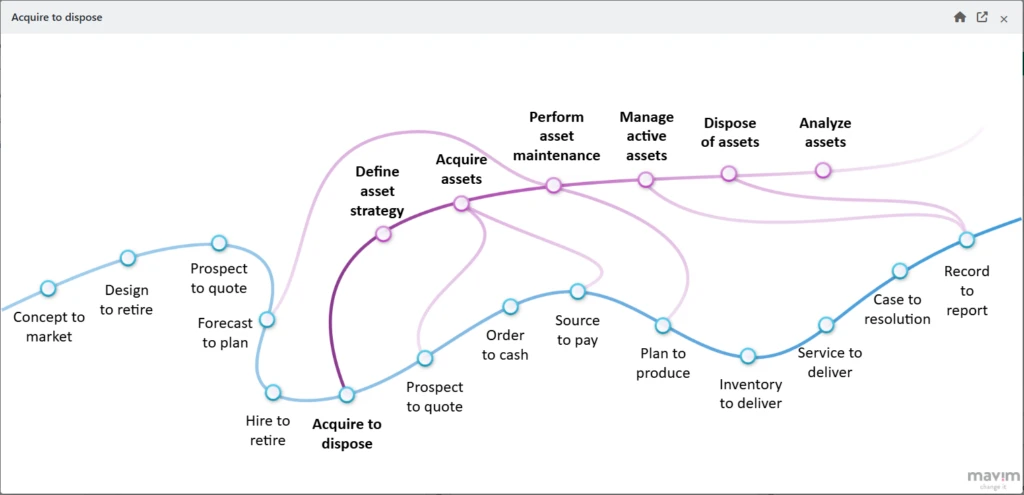
New capabilities include:
- Opening and navigating standard business process diagrams from the Microsoft Business Process Catalog.
- Exploring process hierarchies to support discovery and implementation planning.
- Identifying business processes that are in scope or out of scope for the project.
- Working with business process content directly within the project profiling experience.
These capabilities provide additional context during one of the most important phases of an implementation: defining what the organization plans to deliver.
A Shared Foundation for Implementation Planning
Project scope influences nearly every aspect of a Dynamics 365 implementation, from solution design and governance to project planning and delivery. Defining scope early helps align stakeholders. That shared understanding reduces ambiguity throughout implementation.
Incorporating the Microsoft Business Process Catalog into the Implementation Portal creates a common starting point for implementation discussions. Teams can reference standard Microsoft business processes during discovery workshops, evaluate which processes align with business requirements, and document implementation scope within a single experience.
This enhancement can help organizations:
- Align business and technical stakeholders earlier in the implementation lifecycle.
- Ground implementation discussions in standard Microsoft business process guidance.
- Improve consistency across implementation teams by using a shared process framework.
- Maintain traceability between business process decisions and implementation planning.
- Create a stronger process foundation that supports future solution design activities.
Rather than changing how organizations implement Dynamics 365, this enhancement enriches an existing workflow by making business process guidance available where implementation decisions are made.
Kiwa Builds a Common Process Foundation
Organizations are already using the Microsoft Business Process Catalog to support business transformation initiatives. Kiwa, a global testing, inspection, and certification organization, is using Dynamics 365 and the Microsoft Business Process Catalog to help harmonize service operations across more than 200 legal entities in over 40 countries. By establishing a common process framework, the organization can compare current-state and future-state processes, align stakeholders around a shared operating model, and support implementation decisions across global rollouts.
For organizations implementing Dynamics 365 across multiple business units, regions, or legal entities, a common process foundation can support more consistent planning and governance throughout the implementation lifecycle. Read the Kiwa case study.
Availability
Business process visualization in the Implementation Portal for Dynamics 365 is now generally available as part of the standard project profiling experience.
The Implementation Portal is available to customers with eligible Dynamics 365 products and is the primary channel for completing the required Go Live Readiness workshop for finance and operations projects.
This release is an important step toward creating a more connected implementation experience, bringing business process guidance closer to the decisions that shape successful Dynamics 365 projects.
Learn more
Learn more about the Microsoft Business Process Catalog and the Implementation Portal for Dynamics 365 on Microsoft Learn.